.jpeg?width=430&height=266&name=AdobeStock_534476114(1).jpeg)
IT Strategy Planning: The Executive Roadmap for Sustainable Growth
Key Takeaways (TLDR):
- IT strategy planning directly impacts business performance.
When technology aligns with business goals, organizations move faster, reduce friction, and make better decisions with confidence. - Regularly evaluating your technology environment drives efficiency and lowers risk.
Leaders who understand what systems are in place can eliminate bottlenecks, improve productivity, and avoid costly surprises. - A clear IT roadmap turns vision into execution.
Phased planning, ownership, and risk awareness help leadership teams support growth without disrupting day-to-day operations.
Most growth challenges don’t show up in a spreadsheet right away. They show up when teams slow down, systems stop scaling, or leaders hesitate because the technology underneath the business isn’t ready.
IT decisions quietly shape everything from expansion plans to risk exposure and customer experience. The technology you rely on today determines how quickly you can move tomorrow, how well your teams collaborate, and how resilient the business remains when something unexpected happens.
Business leaders who stay ahead don’t treat technology as an afterthought or a series of one-off fixes. In fact, 81% of business leaders view investments in digital transformation services (which is often driven by IT strategy) as essential for success. These leaders plan technology the same way they plan growth, staffing, and market expansion - with intention and long-term outcomes in mind. Instead of reacting to issues, they make deliberate decisions that support where the business is headed, not just what it needs right now.
A well-defined IT roadmap gives leadership clarity. It connects technology decisions directly to business priorities, reduces last-minute disruptions, and helps ensure investments deliver long-term value rather than short-term fixes.
Below are the essential elements of an IT strategy that enable leadership teams to move faster with confidence, manage risk more effectively, and support sustainable growth.
For year-specific guidance, read our IT strategy planning checklist for 2026.
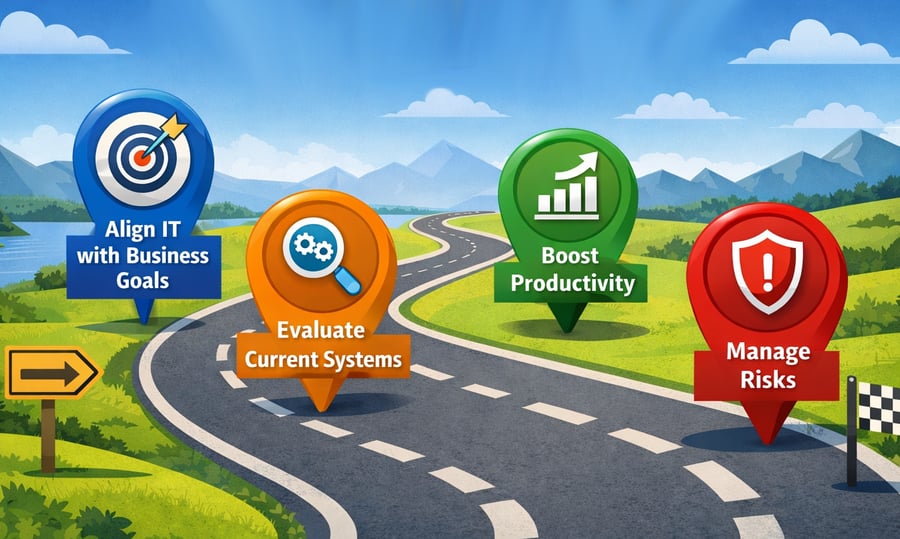
Aligning IT with Business Goals
An effective IT strategy starts with alignment. When technology decisions drift away from business objectives, even well-funded initiatives struggle to deliver results.
This alignment matters more than many organizations realize. Seventy percent of companies say their IT strategy directly impacts overall business performance, yet only 17% report strong alignment between IT and business strategy. That disconnect often explains why technology investments fail to meet expectations.
Alignment begins with clarity at the executive level. Are you focused on scaling operations, improving customer retention, entering new markets, or increasing operational efficiency? Each objective requires different technology priorities.
For example, expansion into new markets demands scalable infrastructure and secure collaboration across locations. A focus on customer retention may require stronger CRM platforms or data-driven insights that personalize engagement. When IT strategy planning reflects these goals, technology becomes a driver of progress rather than a constraint.
This is where a strong partnership matters. At Proper Sky, our Strategic IT Planning Services include a dedicated team that works directly with your leadership to ensure technology decisions support business objectives, not just immediate technical needs.
Evaluating What’s in Place Today
Before moving forward, leaders need a clear understanding of their current technology environment. Evaluating systems, processes, and vendors often reveals inefficiencies that quietly limit growth.
Organizations that regularly assess their IT environments see measurable benefits. Companies conducting detailed technology evaluations report an average 25% increase in operational efficiency, while regular IT reviews lead to 60% better alignment between technology investments and business goals.
This evaluation requires asking direct questions:
- Are current systems supporting productivity or slowing teams down?
- Are legacy tools increasing risk or limiting flexibility?
- Are vendors delivering the value, security, and responsiveness the business requires?
By taking a critical look at what is already in place, leadership gains visibility into where technology supports growth and where it quietly holds the organization back.
Related Case Study: How Philly Nonprofit Turned Legacy IT into Mission-Aligned Growth
Focus on Productivity Where It Matters Most
A strong IT strategy removes friction from everyday work. When employees spend less time navigating systems and more time executing priorities, productivity improves across the organization.
This impact is measurable. Sixty-three percent of employees say digital tools directly improve productivity, and organizations investing in automation and AI report performance gains at similar rates. AI adoption continues to accelerate, with 77% of professionals saying it helps them work more effectively and confidently.
Automation, smarter workflows, and better system integration allow teams to focus on higher-value work. Sales teams close deals faster. Finance teams gain clearer insight. Operations teams make decisions with real-time data.
Technology does not replace people. It enables them to perform at their best.
Build a Realistic Plan with Risk in Mind
Strategy only creates value when execution follows. A practical IT roadmap turns vision into action while minimizing disruption.
Successful IT planning breaks initiatives into phases, defines ownership, and establishes measurable outcomes. It also accounts for risk. System migrations, security upgrades, and platform changes all introduce potential exposure if not managed properly.
Organizations increasingly recognize this reality. Seventy-four percent now implement structured continuity and data protection strategies, reflecting the growing importance of resilience and risk management in technology planning.
By identifying risks early and planning mitigation strategies such as testing environments, backups, and clear communication, leadership avoids costly surprises and protects business continuity.
Build Your IT Roadmap Today
IT strategy planning is not about technology alone. It is about ensuring the business can grow, adapt, and compete with confidence.
When IT aligns with business goals, evaluates current capabilities, improves productivity, and accounts for risk, it becomes a powerful driver of success. Leaders gain visibility. Teams gain efficiency. The organization gains momentum.
If your business needs help crafting an IT roadmap that delivers measurable outcomes, our team at Proper Sky is here to help. With expertise in aligning IT solutions with business goals, optimizing systems, and improving productivity, we’ll ensure your technology works as a true partner in your success.
Let’s build the roadmap to your business’s future together. Reach out today for your IT strategy evaluation!