.jpeg?width=430&height=266&name=AdobeStock_534476114(1).jpeg)
Small Business Cybersecurity: 2025 Lessons learned for 2026 Success
Key takeaways:
-
Cybersecurity is a business risk, not just IT — identity-based attacks, AI-powered phishing, and vendor access are now the primary ways SMBs get breached.
-
Focus on what actually stops attacks — phishing-resistant MFA, layered email security, strong financial verification, vendor least-privilege, and secured IoT devices.
-
Work with a security-first MSP — 24/7 monitoring, proactive detection, and clear incident response matter more than adding more tools.
2025 Was a Wake-Up Call for Small Business Cybersecurity
If you still think cybersecurity is just an IT problem, 2025 should have changed your mind. The 2025 Verizon Data Breach Investigations Report found that small and medium-sized businesses are being targeted nearly four times more than large organizations, with ransomware present in 88% of breaches affecting SMBs compared to just 39% for larger enterprises.
Why are cyber threats for small businesses escalating? Attackers have done the math. Small businesses lack dedicated security teams, operate with constrained budgets, and maintain complex vendor relationships - all while holding valuable data. They're easier wins with less resistance.
Throughout 2025, the biggest small business cybersecurity threats came from five critical areas: compromised identities, manipulated email communications, exploited vendor relationships, AI-powered attacks, and vulnerable connected devices. Here's what actually happened, what it cost, and what you can do about it.
Ransomware Attacks on Small Businesses: Still the #1 Business Disruptor
Ransomware didn't just survive in 2025 - it evolved into the dominant threat facing SMBs. According to Sophos, ransomware cases accounted for 70% of incident response cases for small businesses, rising to over 90% for midsized organizations.
What changed in ransomware attacks on small businesses:
- Attack timelines accelerated dramatically
- Data exfiltration became standard - attackers now steal data and threaten to publish it, even without encryption
- Backups became primary targets, rendering traditional recovery plans useless
- Ransomware demands increased by 140% throughout 2024-2025
The financial reality: Average recovery cost was $1.53 million according to Sophos, excluding any ransom payment. That includes downtime, lost productivity, remediation, legal fees, and customer notification. For context, the average cost of a cyber breach for SMBs is $120,000 per incident, which can be catastrophic for businesses with limited reserves.
What we learned about SMB cybersecurity:
- Backups are necessary but not sufficient - they must be immutable, regularly tested, and stored separately
- Unpatched vulnerabilities played a role in nearly 15% of intrusions, with exploited vulnerabilities the most common ransomware root cause at 32%
- Organizations that detected ransomware before encryption had dramatically better outcomes
Your MSP should provide: 24/7 managed detection and response, immutable backup solutions, regular recovery testing, and proactive patch management.
AI-Powered Cyber Attacks and Deepfakes: The Game-Changer of 2025
If 2024 introduced AI-powered cyber attacks, 2025 made them mainstream. AI-enabled cyber attacks rose by 47% globally in 2025, with 68% of cyber threat analysts reporting that AI-generated phishing attempts are harder to detect than in any previous year.
The evolution was dramatic. By 2025, 67.4% of all phishing attacks utilized some form of AI, creating nearly perfect impersonations of writing styles, email formats, and even voice patterns. But the most alarming development was the rise of deepfake technology targeting small businesses.
Deepfake-as-a-Service (DaaS) emerged as one of the fastest-growing tools for cybercriminals. AI-powered deepfakes were involved in over 30% of high-impact corporate impersonation attacks in 2025, with AI-generated CEO and executive impersonations causing losses exceeding $200 million in just the first quarter alone. Deepfake fraud cases surged 1,740% in North America between 2022 and 2023, and that acceleration continued through 2025. The numbers are staggering: deepfakes online surged by 550% from 2019 to 2023, with projections reaching 8 million by 2025.
Common AI-powered attack scenarios:
- Video calls with "executives" approving fraudulent wire transfers using deepfake video and voice
- AI-generated emails that perfectly mimic executive communication styles, bypassing traditional email security
- Voice deepfakes used to verify fraudulent transactions over the phone
- Sophisticated spear-phishing campaigns personalized using AI analysis of social media and public data
What we learned about AI cyber threats:
- Traditional verification methods are no longer sufficient - a video call or phone call can be faked
- Out-of-band verification is critical - use separate communication channels with pre-established codes or questions
- Financial transaction policies must assume impersonation is possible
- Cybersecurity professionals reporting being least prepared for deepfake attacks rose from 3% in 2024 to 21% in 2025
Your MSP should provide: AI-enhanced threat detection, deepfake awareness training, multi-channel verification protocols for financial transactions, and voice/video authentication solutions where appropriate.
Business Email Compromise (BEC): Low-Tech, High Impact on SMBs
While everyone focused on sophisticated malware, the most profitable cybercrime of 2025 required no malware at all. Business email compromise (BEC) was the seventh most reported crime to the FBI's Internet Crime Complaint Center in 2024, but ranked second in financial damage at close to $2.8 billion in losses. Nearly $8.5 billion in BEC losses were reported between 2022 and 2024.
BEC attacks succeeded because they bypassed traditional security tools entirely - no suspicious attachments, no malicious links. Just carefully crafted emails appearing to come from executives, vendors, or customers requesting wire transfers, payroll changes, or sensitive information. And with AI making these attacks even more convincing, business email compromise became an even more severe threat throughout 2025.
Common BEC scenarios in small businesses:
- Invoice fraud with altered bank account details
- Payroll redirection to attacker-controlled accounts
- Vendor impersonation from compromised accounts
- Executive spoofing for urgent wire transfers
What we learned about email security for SMBs:
- Email security must be layered—filtering, DMARC/DKIM/SPF authentication, and visual indicators for external emails
- User awareness equals technical controls in importance
- Financial workflows need verification—dual approval for wire transfers and callback procedures for payment changes
- Over 3.4 billion phishing emails are sent per day in 2025
Your MSP should provide: Advanced email security platforms, DMARC/DKIM/SPF implementation and monitoring, ongoing security awareness training, and incident response planning.
Multi-Factor Authentication (MFA) Fatigue Attacks: When Security Becomes the Weak Point
You implemented multi-factor authentication for your small business - good. But what happens when users receive 50 push notifications at 2 AM?
MFA fatigue attacks exploit human psychology. Microsoft recorded over 382,000 MFA fatigue attacks during a 12-month period, with about 1% of users accepting a simple approval request on the first try. Attackers with stolen passwords repeatedly trigger MFA requests until frustrated users approve one just to stop the notifications.
Why SMBs were vulnerable to MFA attacks: Most chose the simplest MFA option - push notifications - creating new vulnerabilities with no context, no verification, no rate limiting, and limited monitoring.
What we learned about MFA best practices:
- Number matching eliminated MFA fatigue attacks when enabled, according to Microsoft
- Identity is the new perimeter - compromised credentials provide legitimate-looking access
- Credential abuse represented 22% of breaches in the 2025 Verizon DBIR
- Monitoring authentication behavior is critical for small business cyber security
Your MSP should deliver: Conditional access policies, phishing-resistant MFA like number matching, identity threat detection, and adaptive authentication.
IoT Security Vulnerabilities: The Forgotten Attack Surface
As small businesses increasingly adopted smart office devices, security cameras, HVAC systems, and connected equipment, they unknowingly expanded their attack surface. By 2025, more than 50% of IoT devices had critical vulnerabilities that hackers could exploit, and one in three data breaches involved an IoT device.
The scale was staggering: approximately 820,000 daily attacks targeted IoT devices in 2025. These devices became the weak link in otherwise secure networks, creating massive IoT security vulnerabilities for SMBs.
Most IoT devices ship with default credentials that are rarely changed after installation, creating an open door for attackers who know the standard passwords. These devices seldom receive security updates, leaving known vulnerabilities unpatched for months or years. Network segmentation strategies often ignore IoT devices entirely, allowing compromised smart thermostats or security cameras to access the same network as sensitive business data. Perhaps most troubling, many businesses face significant visibility gaps - they can't even inventory their connected devices, much less secure them properly.
Common IoT attack scenarios:
- Compromised security cameras providing network access
- Smart building systems used as entry points for ransomware
- Botnet recruitment of vulnerable devices for DDoS attacks
- Data exfiltration through poorly secured printers and copiers
What we learned about IoT security for small businesses:
- IoT devices require the same security scrutiny as computers and servers
- Network segmentation is critical - IoT devices should operate on isolated networks
- Default credentials must be changed immediately upon installation
- Regular firmware updates and device inventory management are non-negotiable
Your MSP should provide: IoT device discovery and inventory, network segmentation strategies, automated vulnerability scanning for connected devices, and firmware update management.
Supply Chain Attacks and Vendor Risk: Trust Became the Attack Vector
The 2025 Verizon DBIR found that third-party involvement in breaches doubled to 30%, up from 15% in 2024. Rather than attacking hundreds of SMBs individually, sophisticated threat actors compromised single vendors or MSPs serving hundreds of customers. In fact, 59% of companies have experienced a data breach caused by a third party or vendor with whom they have shared sensitive information.
Common supply chain risks for SMBs:
- Compromised MSP remote management tools providing access to dozens of client environments
- Insecure SaaS platforms - the Sisense breach in April 2025 prompted CISA to advise customers to reset all credentials
- Poor vendor access controls kept active long after projects ended
- Supply chain attacks generate the highest average claim values at $265,000
What we learned about vendor risk management:
- Vendor risk management is no longer optional for small businesses
- Least privilege applies to vendors too - scope permissions to specific systems
- MSP transparency matters - ask about their SOC 2/ISO 27001 certifications, client environment segmentation, and incident response procedures
Your MSP should provide: Vendor risk assessments, secure remote access controls, client-facing security documentation, and incident notification procedures.
What These Small Business Cybersecurity Threats Had in Common
Looking across all 2025 SMB cybersecurity threats, patterns emerge:
- Identity-based attacks: Credential abuse remained the dominant attack vector across all small business sectors
- Abuse of trust: Attackers walked through open doors by impersonating trusted parties - executives, vendors, IT support - with AI making impersonations nearly perfect
- Human behavior as entry point: Organizations cited an average of 2.7 factors contributing to ransomware attacks, with lack of expertise most common at 40.2%
- Expanded attack surface: Connected devices and AI tools created new vulnerabilities many businesses didn't know they had
- Lack of visibility: Organizations detecting threats early fared dramatically better than those discovering breaches months later
- Resource constraints: 32% of SMBs don't have enough budget to hire more staff, and 20% report having no cybersecurity technology at all
The key takeaway: The biggest cybersecurity failures of 2025 weren't caused by missing tools - they were caused by missing cybersecurity strategy.
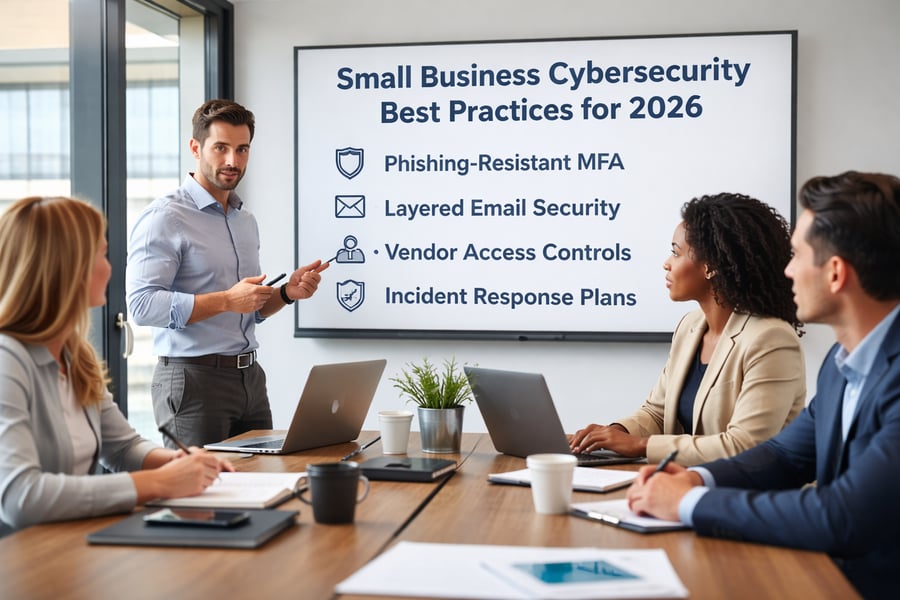
Small Business Cybersecurity Best Practices for 2026
Cybersecurity is no longer just an IT issue — it’s a core business risk. If your systems were unavailable for days, revenue, operations, and customer trust would be immediately impacted. In 2026, SMBs must prioritize identity security, email protection, vendor access controls, and emerging risks like AI-driven social engineering and vulnerable IoT devices.
The most effective approach focuses on phishing-resistant MFA, layered email security with user training, strong verification for financial transactions, least-privilege vendor access, secured and segmented IoT devices, and tested incident response plans. Partnering with a security-first MSP that provides 24/7 monitoring, proactive threat detection, and expertise in AI and supply-chain threats is essential to staying protected and resilient.
Protect Your Small Business from Cyber Threats in 2026
The small business IT and cybersecurity threats facing SMBs in 2025 weren't entirely new - but the scale, sophistication, and focus on smaller organizations marked a clear shift. AI-powered attacks and vulnerable IoT devices added new dimensions to familiar threats like ransomware attacks on small businesses and business email compromise.
The statistics are sobering: 43% of all cyberattacks target small businesses, 60% of small businesses fold within six months of a major breach, and cybercrime is set to cost businesses up to $10.5 trillion by 2025. But the good news? These cyber threats for small businesses are predictable and preventable with the right strategy.
If you're not sure how exposed your business may be, now is the right time to assess - before attackers do.
Schedule a comprehensive security assessment to identify gaps in your identity protection, email security, vendor access controls, IoT security, and backup strategies. Our team will provide a detailed report of vulnerabilities and a prioritized roadmap for addressing them.
Don't wait until you're recovering from an incident. The organizations that thrived in 2025 weren't the ones with unlimited budgets - they were the ones with clear strategies and the right partnerships.
Contact us today for a confidential security assessment. Let's ensure your business enters 2026 protected, prepared, and positioned for growth instead of recovery.
Frequently Asked Questions About Small Business Cybersecurity Threats
- What are the biggest cybersecurity threats for small businesses in 2025? The top SMB cybersecurity threats in 2025 include ransomware attacks, AI-powered phishing and deepfakes, business email compromise (BEC), MFA fatigue attacks, IoT security vulnerabilities, and supply chain attacks through compromised vendors.
- How much does a cyber attack cost a small business? The average cost of a cyber breach for small businesses is $120,000 per incident, with ransomware recovery costs averaging $1.53 million. Supply chain attacks generate the highest claim values at $265,000 on average.
- What percentage of cyberattacks target small businesses? 43% of all cyberattacks target small businesses, with 88% of SMB breaches involving ransomware compared to just 39% for larger enterprises. Small businesses are targeted nearly four times more than large organizations.
- How can small businesses protect against AI-powered cyber attacks? Implement multi-channel verification for financial transactions, deploy AI-enhanced threat detection, provide deepfake awareness training, use phishing-resistant MFA, and establish out-of-band verification protocols with pre-established security questions.
- Why are IoT devices a cybersecurity risk for small businesses? Over 50% of IoT devices have critical vulnerabilities, with approximately 820,000 daily attacks targeting these devices. They often have default credentials, rarely receive updates, and lack proper network segmentation, making them easy entry points for attackers.